You can download latest report from AppDynamics who is named leader.
https://www.appdynamics.com/the-forrester-wave-application-performance-management/

You can download latest report from AppDynamics who is named leader.
https://www.appdynamics.com/the-forrester-wave-application-performance-management/
As agile is getting into more and more software development teams so is the importance of pair-programming.
At core pair-programming is all about two people sharing single development workstation and working on same development task. They code & watch/review in turns.
While at first look it just seems to be wastage of efforts, the reduction in time taken to complete the task and improvement in quality of code delivered, outweighs any additional effort. Here are some statistics:
Read the below paper and start practicing pair-programming today.
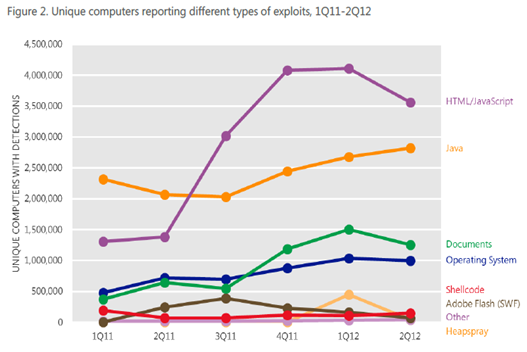
Latest edition of Microsoft Security Intelligence Report is out.
Volume 13 of the Microsoft® Security Intelligence Report (SIRv13) provides in-depth perspectives on software vulnerabilities and exploits, malicious code threats, and potentially unwanted software in Microsoft and third-party software. Microsoft developed these perspectives based on detailed trend analyses over the past several years, with a focus on the first half of 2012.
HTML/Javascript continues to top the list when it comes to being platform for exploits.
You can download the full detailed report from here.
http://www.microsoft.com/en-us/download/details.aspx?id=34955
Industry and government decision makers are increasingly aware that operational security protections and regulatory compliance are insufficient in protecting global applications and infrastructures. Organizations are realizing the value of Security Development Lifecycle (SDL) practices and seek to accelerate adoption and articulate this value to management.
The inaugural Security Development Conference 2012 (SDC 2012) will bring together industry professionals to network and learn from security experts about Security Development Lifecycle (SDL) practices. SDC 2012 will include information for leaders in software engineering, process and business management who are responsible for accelerating the adoption and effectiveness of SDL practices in their organizations.
Under Open Market Data Initiative, Bloomberg has released its market data interfaces as free and open APIs which can be consumed by anyone with no restrictions.
The APIs are available in Java, C, C++ and .NET
Here are some deep links to get started quickly.
http://open.bloomberg.com/pdf/blpapi-developers-guide.pdf
http://open.bloomberg.com/pdf/bloomberg_open_market_data_whitepaper.pdf
On a side thought, they can be a very good reference on how to design high performance public interfaces and APIs.
Microsoft has released a new SDK and Management called “Microsoft Codename Trust Services SDK and Management Tool” to encrypt the data before storing it in the cloud.
Microsoft Codename Trust Services is an application-level end to end encryption-based framework that can be used to encrypt stored content. Data publishers can use Trust Services to encrypt data before it is stored in Windows Azure storage or SQL Azure, and authorized subscribers of data can decrypt data after it is read from storage. Using Trust Services encrypts the data, and helps reduce concerns about unauthorized access to data by Windows Azure administrators and/or unauthorized third parties. Using Trust Services helps address data security, privacy, and sovereignty issues that might block or limit typical scenarios, such as distributing data to branch offices, making data accessible to mobile employees or customers, sharing data across businesses, and leveraging cloud scale for computation and analytics.
Recently Microsoft released its Privacy principles based on which it provides privacy protections in software products and Internet services.
Here are they at high level:
Loughborough University’s study on ‘Privacy Impact Assessments’ is an important work in this field.
On Tuesday December 13th Microsoft will be holding a special Windows Azure event for developers. Join us LIVE from the Microsoft Redmond Campus to learn how to get started building applications for the cloud from Microsoft technical leaders Scott Guthrie, Dave Campbell, and Mark Russinovich. All of the sessions will be broadcast live thanks to your friends from Channel9.
The Learn Windows Azure Event will be held from 9 a.m. to 5 p.m. PST on Tuesday December 13th. Add this time to your calendar and come back to Channel9 on December 13th to watch the live stream. We also have a limited number of seats available for the in-person studio audience. Register now if you would like to reserve a seat to attend the Learn Windows Azure event for free at the Microsoft Redmond Campus.
This is the third post of the series discussing the recently released ISO standard for Architecture Description.
Post 1 : Understanding ISO/IEC/IEEE 42010:2011 : Standard for Architecture description
Post 2 : Communicating Architecture : Key Terms of 42010
While the standard defines various elements of Architecture Description and their relationships, it also specifies requirements which should be complied with for conformance.

The Standard defines four cases of conformance:
Here are the primary requirements for each component:
Architecture Description (AD)
Architecture Viewpoint
Architecture Description Language
Architecture Framework
This is in continuation to my earlier post Understanding ISO/IEC/IEEE 42010:2011 : Standard for Architecture description. If you have landed directly to this post, I recommend to read the earlier post first.
Reposting the conceptual model of the Standard for easy reading.
In this I will discuss the key terms of the Standard.
Architecting : contributes to the development, operation and maintenance of a system from its initial conception through its retirement from use and disposal. It is performed throughout the system life cycle.
AD Element : Architecture Description Element. The most primitive construct in AD. Every stakeholder, concern, architecture viewpoint, architecture view, model kind, architecture model, architecture decision and rationale is considered an AD element.
Stakeholders : anyone who has interest in the system. e.g.
Concerns : interest in a system relevant to one or more of its stakeholders. e,g, technological, business, operational, performance, resource utilization, etc.
Viewpoint : establishes the conventions for the construction, interpretation and use of architecture views for specific concern(s). A concern can be framed by more than one viewpoint. Viewpoint conventions can include
languages, notations, model kinds, design rules, and/or modelling methods, analysis techniques and other
operations on views.
View : expresses the architecture of a system from the perspective of specific system concern(s) in accordance to its Viewpoint.
Model Kinds : conventions for a type of modelling. e.g. class diagrams, data flow diagrams, etc.
Architecture Model : An architecture model uses modelling conventions appropriate to the concerns to be addressed. These conventions are specified by the model kind governing that model. Within an architecture description, an architecture model can be a part of more than one architecture view.
Rationale : Architecture rationale records explanation, justification or reasoning about architecture decisions that have been made. The rationale for a decision can include the basis for a decision, alternatives and trade-offs considered, potential consequences of the decision and citations to sources of additional information.
Decision : something which affect the architecture in context of a concern.
Correspondence Rules : Correspondences are governed by Correspondence Rules.
Correspondences : defines a relation between AD elements. Correspondences and correspondence rules are used to express and enforce architecture relations such as composition, refinement, consistency, traceability, dependency, constraint and obligation.
Architecture Framework : conventions, principles and practices for the description of architectures established within a specific domain of application and/or community of stakeholder. Uses of architecture frameworks include, but are not limited to: creating architecture descriptions; developing architecture modelling tools and architecting methods; and establishing processes to facilitate communication, commitments and interoperation across multiple projects and/or organization. e.g.
Architecture Description Language (ADL) : An ADL provides one or more model kinds as a means to frame some concerns for its audience of stakeholders. An ADL can be narrowly focused, defining a single model kind, or widely focused to provide several model kinds, optionally organized into viewpoints. Often an ADL is supported by automated tools to aid the creation, use and analysis of its models. e.g.


Part 2 : Communicating Architecture : Key Terms of 42010
Part 3 : Architecture Description confirming to ISO Standard
Businesses & CIOs across the world see lot of value in going Agile for Software Development. Development teams also have been quick enough in adopting the Agile methodologies. But in majority of cases, teams have failed to capitalize on the value of Agile development and in fact reduced their efficiencies by going Agile. There is also a trend where teams have started reverting back to the old way of software development.
The primary reason for this failure is that teams have failed to understand what it takes to get value out of Agile. Just by doing SCRUM or hiring a Scrum master doesn’t make you agile. In fact it creates chaos. Going Agile is a multi-dimensional approach and is based on three foundation pillars. If the team is not matured enough in even one of these, they will fail to get value out of going Agile. Higher the maturity in these pillars, more effective the agile approach will be.
The foundation pillars of Agile Development are:
1. Test Driven Development. It is about coding against tests instead of requirements. Requirements are translated into test cases and developers code to satisfy those test cases. This considerably reduces the testing cycle but increases focus on writing right test cases.
2. Agile Project Management. This is about correctly prioritizing the requirements and right sizing the iterations. I am sure everyone must have heard stories about Google having a sprint cycle of 2 days and Facebook having it of less than a day. Start with a sprint size with which the team is comfortable, even if it is 30 days. As you mature in other 2 pillars, you can start reducing your sprint duration.
3. Continuous Integration & Deployment. This is the last leg of an iteration and requires lot of support from tools. It involves building & integrating the code frequently, running automated tests and moving it to production. Some of the tools like Microsoft TFS, Cruise Control and others can help in this.
So, if you are planning to go agile for your development make sure you address it from all sides.
So finally, the technology has started moving on the client side of web too, faster than we expected. After many years of using HTML, JavaScript, ActiveX, Flash & Silverlight came the big innovations like HTML5 & CSS3.
Here comes the latest from Google, called DART – Structured Web programming language. Personally I have never been happy with JavaScript due to readability, maintainability & lack of support of good developer tools.
So what is DART ? Here are few highlights:
Google promises to provide the right tooling support to leverage the enhancements done over javascript in Dart.
Design goals of Dart as mentioned by Google :
Deployment/Execution Models
Dart & HTML5 – Dart will have HTML5 Dom library to interact with HTML elements
I feel Dart will help in making the web richer without compromising the developer productivity. JQuery is helping a lot currently in this aspect on top of JavaScript. Based on the acceptance of Dart, JavaScript may continue to remain popular.
It would have been better if instead of releasing a new language, Google had advocated such advances in JavaScript itself.
With Google Chrome making big advances and may soon become second most popular browser, it could dare to take such a bold step.